Core Course
Client
Wall Street English
Problem
As online education continues to evolve, Wall Street English approached us to help revolutionise its Core Course delivery through the introduction of a new design system and updated front-end technology framework. While the organisation possesses strong foundational learning content, platform engagement metrics indicate an opportunity to enhance the overall user experience for a more cohesive customer journey.
Key challenges
The following assumptions were identified from user insights through user research, stakeholder interviews and an experience audit.
Poor completion & motivation lead to low customer retention
30% of paid customers fail to study each month
60% of students take longer than 3 months to complete first level, once behind it is hard to catch up
Students don't engage with Encounters (online classroom activities)
20% of students fail to attend any class at all
Only 50% of students attend optional classes
Only 30% of students book and manage their own classes
Increase registrations and improve onboarding
Current registration process is clunky and intervention heavy (we will get in contact, come to a center)
Onboarding is primarily about learning model, not about using the product.60% of students take longer than 3 months to complete first level, once behind it is hard to catch up
Promote regular study habits
Only half complete in the suggested 6 hours
Opportunity
For this project, our core focus was delivering solutions rapidly that could be tested with users. This allowed us to quickly validate whether concepts were viable to hand off to the client's in-house product development team for full implementation on their platform.
We opted for an experiment-driven approach. Every two weeks, we conducted a design sprint that included user research, ideation sessions, iterative design, and interactive prototyping - all culminating in user testing.
A key aspect was defining clear success metrics for each experiment. This enabled us to objectively evaluate whether an experiment passed inspection and was ready for hand-off, or if it required further iteration.
When an experiment met all success criteria, we seamlessly transitioned it to the client's product team. They could then take that validated concept and build it into a fully-realised experience on their live platform. This lean process allowed us to rapidly test ideas with real users before investing significant resources.
We completed 7 experiments in total, here are some of my favourite ones.
Experiment 1
Placement Test
Right off the bat when new learners sign up for the core course platform, they have to take a placement test. The goal? Seeing what their English skills are at so we can get them started in the perfect module.
The problem was that the original placement test felt outdated - it was overly complicated, and the user experience was in need of a visual revamp. Because of this, learners were getting the impression that investing their time and money into the platform might not be worth it.
Our mission was to completely transform this initial experience. We wanted to craft an intuitive, impressive user journey from the moment learners started the placement activities. By enhancing every step and giving the whole journey a modern design overhaul, we aimed to hook new learners right away and drive more conversions.
It was all about making an amazing first impression that motivated learners to fully commit to our platform as the ideal solution for achieving their English goals. With a seamless, engaging placement process, we could get new students excited to begin their learning path with us.
Try out the early prototype for the Placement Test.

Experiment 2
Conversational AI
One of the needs we discovered during our early user research was a desire to have more opportunity to practice speaking in a conversational way. Although the learners had opportunity to speak in online classroom situations, this was very specific to the learning module and some didn’t feel confident to use it as a space to speak freely.
This led us to explore a solution revolving around AI. Wall Street English lessons are based around a custom made sitcom that learners watch and complete activities based on each episode. We wanted to explore creating an AI avatar of the characters from the sitcom and allow the learner to have a relaxed conversation with this character based on a topic. They would then be able to review their conversation at the end. This would allow them to practice in private and build up confidence for classes.
We first built a Figma prototype showing the capability, to gather user feedback and then continued on to an MVP version for testing.
Watch the video below to see the prototype in action.
Experiment 3
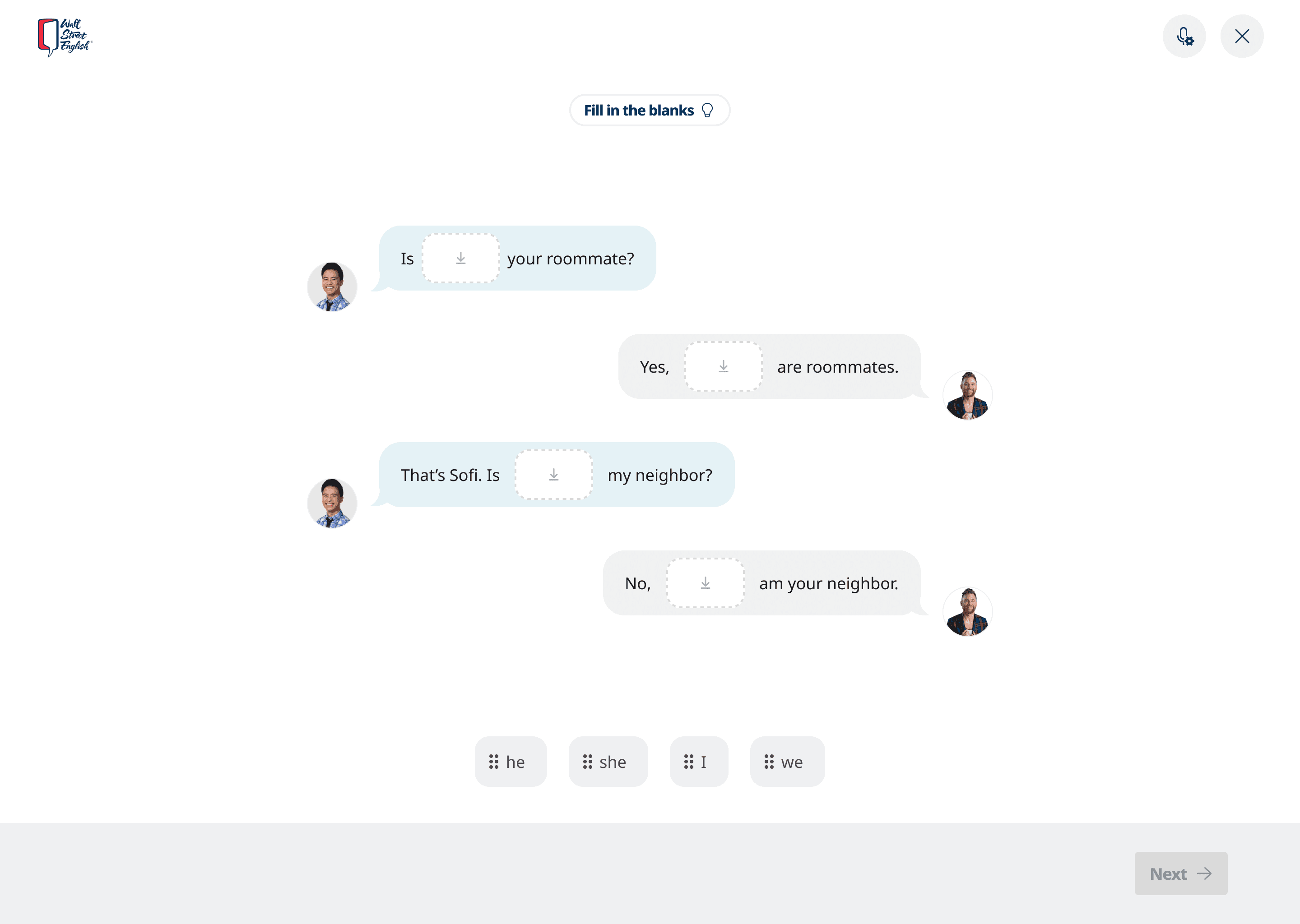
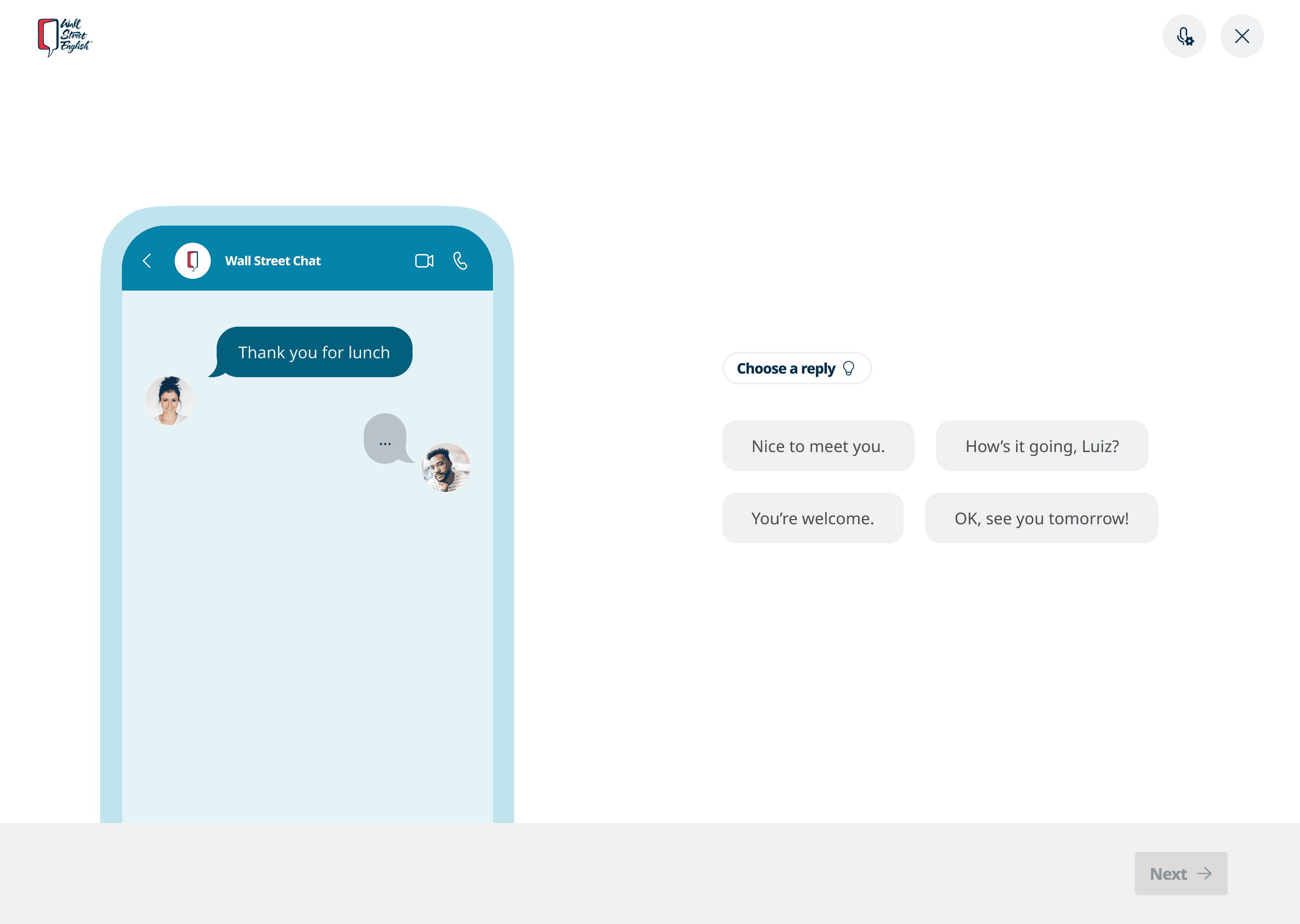
Activity Interactions
One of our biggest hurdles was boosting learner motivation to stick with their studies and build solid habits. Through our research, we found that learners felt the platform was clunky and outdated. Even the exercises themselves didn't feel intuitive or enjoyable to use.
When we completed auditing all the different activity interactions, we quickly realised overhauling this wasn't going to be a walk in the park. Each interaction had multiple variations depending on the level, module, and where it showed up in an activity.
This meant we needed to go all-in on redesigning the entire activity experience from the ground up. We made sure to thoroughly map out and account for every possible scenario and use case. It was a huge undertaking, but critical for creating a consistent, engaging experience that would finally get learners excited to study.
The goal was an intuitive, modern platform full of interactive exercises that actually made progressing through the material fun. By transforming the core activities into something learners enjoyed using, we could motivate them to build long-lasting study habits and achieve their English goals with us.